India, along with Southeast Asian countries such as Indonesia, is expected to sustain growth in the medium-term in Asia region, replacing China as the key growth driver, Morgan Stanley and Nomura said in two separate reports released on Monday. While Morgan Stanley projected a 6.2 per cent gross domestic product (GDP) growth forecast for India in FY24, Nomura estimated the Indian economy to grow at 5.9 per cent in 2023. "Even with a slowing China, we expect GDP growth in Asia to sustainably outperform other emerging markets and the US. India and Southeast Asia are set to be the fastest-growing economies this decade.

The BJP still does not have a majority in Upper House of Parliament, the Rajya Sabha, and this will pose hurdles to the party's legislative reform agenda

Continuing to bet big on reforms agenda of the new government, overseas investors have pumped in nearly Rs 32,000 crore (Rs 320 billion) in Indian equities and debt this month.

India and Brazil on Wednesday called for urgent progress in reforms of the UN Security Council, as they agreed to scale up bilateral ties and deepen cooperation in international fora.


'You cannot treat workers like beggars.'
As a consensus remains elusive on key economic policies like foreign investment norms, industry leader Deepak Parekh has said India's FDI policy is akin to 'inviting guests over to our house, but not opening the door'.

The outcome is beyond the market's expectation and will be a sentimental boost, say analysts.
Attributing the growth to an upswing in consumption and investment, the World Bank has said India will continue to be the fastest growing major economy in the world.
India's sovereign rating could be cut if the government loosens fiscal policy in the run-up to elections, says Fitch.

Post-elections, the pace is expected to be greater for inbound deals, which have been largely pushed back for many months now for want of better clarity on the policy stance of new government, experts said.

Will help in reviving the economy and push investment.

Most brokerages have maintained their Sensex and Nifty targets as they believe there is little room for further re-rating in the backdrop of weak earnings.

At a critical time in the history of the United Nations, when the global order itself may be reshaped, following a devastating pandemic, India has chosen an experienced, charming and upright diplomat to lead the Indian delegation to the UN in New York.
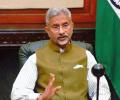
External Affairs Minister S Jaishankar will arrive in New York on Sunday to participate in the high-level 77th session of the UN General Assembly, which kicks off on September 20 with the opening of the general debate.

The International Monetary Fund (IMF) on Tuesday said it is expecting some slowdown in the Indian economy next fiscal year and projected the growth to 6.1 per cent from 6.8 per cent during the current fiscal ending March 31. The IMF on Tuesday released the January update of its World Economic Outlook, according to which the global growth is projected to fall from an estimated 3.4 per cent in 2022 to 2.9 per cent in 2023, then rise to 3.1 per cent in 2024. "Our growth projections actually for India are unchanged from our October Outlook.

'India need to look beyond the economic prism.' 'China had no qualms in taking the Kashmir issue to the UN Security Council last year -- not once, but thrice -- thus violating Indian sensitivities,' observes China expert Srikanth Kondapalli.
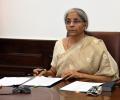
Union Finance Minister Nirmala Sitharaman will on Monday meet chief ministers and state finance ministers to discuss measures to attract private investments to help boost the economy. Finance secretary T V Somanathan said the meeting comes in the backdrop of strong economic recovery post the two COVID waves, and the central government has made a big push in Capex. The focus of this interaction will be on state-level issues, opportunities and challenges, which will enable us to go to a higher trajectory of investment and growth, he said.

India's economy is not like Western ones, and thus needs restrained fiscal policy even during a recession, says Ajay Shah.

That is what you will hear again after Nirmala Sitharaman presents a speech that will prove to be meaningless and numbers that will show themselves to be wildly off the mark, observes Aakar Patel.

The Indian economy recovered from the Covid-induced downturn during 2022 and is poised for further improvement in the coming quarters though downside risks emanating from geopolitical tensions, strengthening dollar and elevated inflation will continue. The positive trajectory in the growth trend and improved fundamentals will help the nation in neutralising the impact of global headwinds which are expected to have a bearing on the country's exports in the months to come. The challenges before the government and the Reserve Bank in the new year would be to arrest inflation, check declining value of rupee against US dollar and promote private investment and growth, with a view to ensure that the country remains one the fastest growing major economies of the world.

Stock market minnows put up a stellar show in 2021 giving returns of up to 60 per cent amid Dalal Street dream run and are likely to continue sailing northwards in the New Year too. Trumping pandemic-induced uncertainties, the Indian equity market posted stunning gains this year achieving several feats and smaller stocks benefited the most from the strong momentum. From reaching the momentous 50,000-mark in January to scaling 61,000-level in October, the BSE Sensex had an epic journey this year.

FDI in brownfield investment has resulted in acquisition of domestic drug-manufacturing firms by multinational companies.

The department of economic affairs, in its Monthly Economic Review for September, said critical reforms undertaken by the government will put India to a strong and sustainable growth path in the long run.
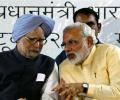
NDA under Mr Modi is as focused on the rural poor with doles and hand-outs as the UPA under Dr Singh was.

Other ministers who have presented five straight annual financial statements include Arun Jaitley, P Chidambaram, Yashwant Sinha, Manmohan Singh and Morarji Desai.

'It would be a huge mistake to think that Gorbachev's reforms did not achieve anything.' 'We all live in the world, which is in many respects a result of Glasnost and Perestroika.'

The most immediate challenge for growth is the disruption of the global economy brought about by the Ukraine war and related sanctions, the Covid shutdowns in China and the rising tide of inflation, points out Nitin Desai.

The ones who came more recently were clutching the green cards that gave them an escape hatch through which to return to green pastures: Arvind Panagariya, Raghuram Rajan, Arvind Subramanian and other perfectly honourable gentlemen like them, points out T N Ninan.

'Breaking down silos and ensuring a more integrated governance process is just as important to performance.' 'It has been a major priority in the last six years, especially in national security,' External Affairs Minister Dr Subrahmanyam Jaishankar points out when delivering the Sardar Patel Memorial Lecture-2020: India and the Post-Covid World.

"As Prime Minister (Narendra) Modi said in his latest campaign, 'Modi hai to mumkin hai,' or 'Modi makes it possible', I'm looking forward to exploring what's possible between our people," Pompeo said in his major India policy speech at the India Ideas Summit of US-India Business Council on Wednesday.

'What we have to think about is, how to improve the efficiency of public sector banks.' 'You have to make decision-making more prudent, and free from government intervention.'

She would be the first Indian to be occupying the coveted post at IMF after former RBI governor Raghuram Rajan

Ajay Banga was on Wednesday appointed the next president of the World Bank, becoming the first-ever Indian-American to head the global financial institution which said it looks forward to working with him at a time when it's tackling the toughest development challenges facing developing countries. "The executive directors of the World Bank today selected Ajay Banga as president of the World Bank for a five-year term beginning June 2, 2023," the bank said in a press statement. In February, President Joe Biden announced that the US would be nominating Banga, 63, to lead the World Bank because he is "well equipped" to lead the global institution at "this critical moment in history."

The only real solution to the jobs crisis, whether in India or abroad, is to direct tech innovation towards job enhancing sectors, and disincentivising job-replacing ones, observes R Jagannathan.
.jpg)
The toxic brew of fiscal populism, crony capitalism and bad economic management has ensured the collapse of economic growth, industrial stagnation, stubbornly high consumer inflation, declining savings and investment, shrinking employment opportunities, and a dangerously vulnerable external financing situation.

Here's the full text of address to the nation by President Droupadi Murmu on the eve of the Republic Day 2023.
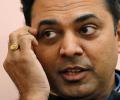
The investment climate is going well in India and the private sector should skill their workforce in the interest of its business, Chief Economic Advisor K V Subramanian said on Thursday asserting that he does not foresee any difficulty in demand and supply of the workforce. Addressing 'Times Network India Economic Conclave', Subramanian further said job creation is part of the virtuous cycle that starts with private investments flowing into the country resulting in production, growth, job creation and increase in aggregate demand which in turn leads to more investments in the economy. The investment climate is going well in India. Other things will follow, though with a lag...it is for the private sector to start recognising that it is in their own business interest that they should skill their workforce. This, in turn, will raise the average level of skills in India," he said.

The protests brought home the fact that the Sri Lankan public is in no mood for halfway measures, as voices against Rajapaksa 'family rule' and 'securitisation' of the civilian administration began sidestepping the more critical economic crisis, affecting the nation and afflicting the individual, observes Sri Lanka watcher N Sathiya Moorthy.
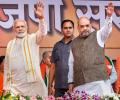
It is worth reconsidering if this fascination with either having a single party majority or Modi's leadership or, indeed, both, is such a great idea for India, says Udit Misra.
